Google Reviews for Law Firms: Complete Guide (2026)
Google reviews for law firms build client trust and drive new consultations. Learn proven strategies, response templates, and ethical tips for attorneys.

Published at:
Updated at:Google reviews for law firms are one of the most powerful client acquisition tools available to attorneys in 2026. Potential clients searching for legal help read reviews before they ever pick up the phone, and firms with strong review profiles consistently win more consultations than those without.
This guide covers everything law firms need to know: why reviews matter for your practice, how many you need by practice type, proven collection strategies that respect bar association ethics rules, response templates for common legal scenarios, and the mistakes that cost firms clients.
If you want to automate your review collection while staying compliant, book a free demo of Endorsa to see how it works for legal practices.
Why Google Reviews Matter More for Law Firms in 2026
Google reviews directly influence whether potential clients contact your firm or scroll past it. According to BrightLocal's 2026 consumer review survey, 98% of consumers read online reviews for local businesses, and legal services are no exception. When someone searches "personal injury lawyer near me" or "family law attorney [city]," Google displays the local pack with star ratings front and center.
Law firms face a unique trust challenge. Clients are hiring you during some of the most stressful moments of their lives: divorces, criminal charges, injury claims, business disputes. The stakes are high, the fees are significant, and the client has no way to evaluate your legal skills before hiring you. Reviews fill that gap. They provide social proof from people who have been through the same experience.
The data backs this up. Whitespark's 2026 study confirms that reviews now account for 20% of local pack ranking factors, making them the second most influential signal after Google Business Profile optimization. For law firms competing in the same metro area, reviews are often the tiebreaker that determines who gets the call.
According to BrightLocal's research, 68% of consumers will not use a business rated below 4 stars. For law firms, where a single client can represent thousands in revenue, every lost consultation adds up fast.
Review Benchmarks by Law Practice Type
The average law firm has between 15 and 40 Google reviews, but the number varies significantly by practice area and market size. Firms in competitive metro areas need more reviews to stand out, while firms in smaller markets can dominate with fewer.
Practice Type | Target Review Count | Typical Rating | Key Factor |
|---|---|---|---|
Personal Injury | 50-100+ | 4.5-4.9 | High competition; volume matters |
Family Law | 30-60 | 4.3-4.7 | Emotional cases; detailed reviews build trust |
Criminal Defense | 25-50 | 4.2-4.6 | Urgency; clients search at crisis moments |
Corporate/Business | 15-30 | 4.5-4.8 | Fewer but more detailed reviews expected |
Immigration | 30-60 | 4.3-4.7 | Multilingual reviews add credibility |
Estate Planning | 20-40 | 4.5-4.9 | Long-term relationships; referral-heavy |
Personal injury firms need the most reviews because competition is fierce and advertising spend is high. A strong review profile reduces your dependence on paid ads by generating organic visibility in the local pack.
For firms just starting their review strategy, the first milestone is reaching 20 genuine reviews. Research from the Spiegel Research Center shows that purchase likelihood increases by 270% when a business goes from zero to five reviews, and the effect compounds as you build toward 20 and beyond.

7 Proven Strategies to Get More Google Reviews for Your Law Firm
Getting more reviews for a law firm requires a different approach than restaurants or retail shops. Clients are dealing with sensitive legal matters, so timing, tone, and ethics all matter.
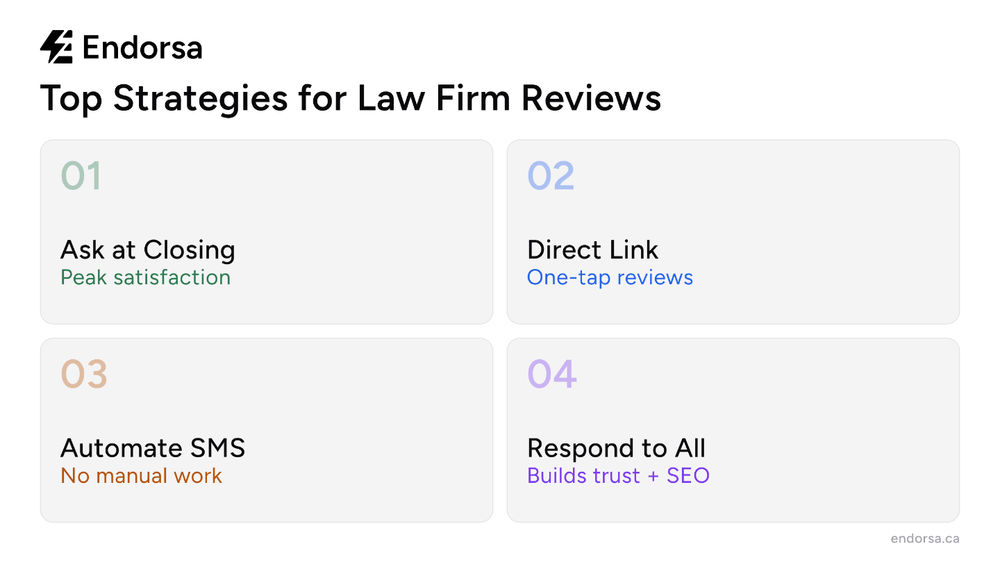
1. Ask at Case Resolution
The best time to request a review is when the client feels relief: after a favorable settlement, a case dismissal, a completed closing, or a finalized estate plan. This is the moment of highest satisfaction and the point where the client is most willing to share their experience. Present the request personally, then follow up with a direct link via email or text.
2. Send a Direct Google Review Link
Make it effortless. Send clients a direct link that opens the Google review form for your firm. No searching, no navigating. You can create a Google review link in under 60 seconds through your Google Business Profile dashboard.
3. Automate Follow-Up Requests
Manual review requests depend on someone remembering to ask, and that fails at scale. Automation tools can send a personalized SMS or email request after a case closes, with a direct review link embedded. This is where platforms like Endorsa fit: we sync your client contacts and send review requests automatically, so no case slips through the cracks.
4. Train Your Intake and Paralegal Staff
Your intake coordinators and paralegals interact with clients more frequently than you do. Train them to identify satisfied clients and make the ask at natural touchpoints: after a successful hearing, after delivering good news, or during the final case wrap-up call. Provide them with a simple script and a link to share.
5. Add QR Codes to Your Office
Place QR codes for Google reviews at your front desk, in waiting areas, and on printed materials. When a client finishes a meeting and feels positive about the interaction, a visible QR code makes the ask frictionless.
6. Include a Review Request in Your Closing Letter
Every case has a closing letter or final communication. Add a brief, warm review request at the end, along with a direct link. This is a low-pressure touchpoint that reaches the client at a moment of closure and gratitude.
7. Respond to Every Review You Receive
Responding to reviews signals to both Google and potential clients that your firm values feedback. Businesses that respond to reviews see a 0.12 star improvement in their overall rating over six months, according to Uberall's research. It also encourages other clients to leave reviews when they see the firm engages.
Ethical Considerations for Attorneys
Bar associations in most jurisdictions allow firms to request Google reviews, but there are rules to follow. Do not offer incentives (discounts, gift cards, fee reductions) in exchange for reviews, as this violates both Google's policies and most bar ethics rules. Do not ask clients to include specific case details that could breach confidentiality. And never pressure a client, especially one in a vulnerable situation.
For Canadian law firms, the Law Society of Ontario and other provincial regulators have advertising rules that apply to online reviews. Additionally, CASL (Canada's Anti-Spam Legislation) governs electronic messages, so review requests sent via email or SMS must include proper identification and consent. Endorsa is a Google review automation platform built in Canada that helps businesses collect, manage, and respond to reviews on autopilot, with CASL compliance built into every workflow.
How to Respond to Law Firm Google Reviews (With Templates)
Responding to law firm reviews requires more caution than most industries because of confidentiality obligations. Never confirm or deny that someone is a client, never reference case details, and keep responses professional even when the review is unfair.
Positive Review (5-Star)
"Thank you for sharing your experience, [Name]. We're glad we could help, and we appreciate you taking the time to leave a review. If you ever need anything in the future, don't hesitate to reach out."
Mixed Review (3-Star)
"Thank you for your feedback, [Name]. We appreciate hearing what went well and where we can improve. We take every client's experience seriously, and we'd welcome the chance to discuss your concerns. Please feel free to contact our office directly."
Negative Review (1-Star)
"We're sorry to hear about your experience, [Name]. Client satisfaction is important to us, and we'd like to understand what happened. Please contact our office directly at [phone/email] so we can address your concerns privately."
Suspected Fake or Competitor Review
"We don't have a record matching this review and believe it may have been posted in error. If you are a client of our firm, please contact us directly so we can resolve any concerns. We've flagged this review with Google for further investigation."
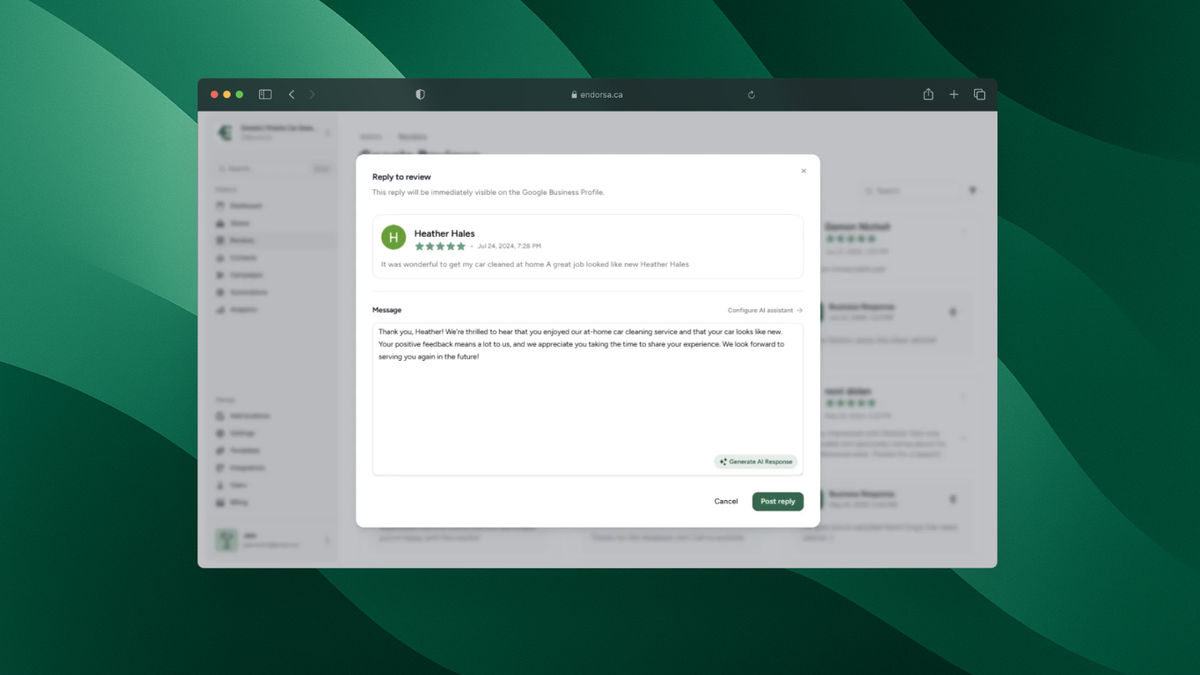
For firms receiving a high volume of reviews, responding individually becomes time-consuming. Our AI review response tool drafts personalized responses that match your firm's tone, so you can review and approve them in seconds rather than writing each one from scratch.
For more response templates covering additional scenarios, see our complete guide to Google review response templates.
Law Firm Review Management Mistakes to Avoid
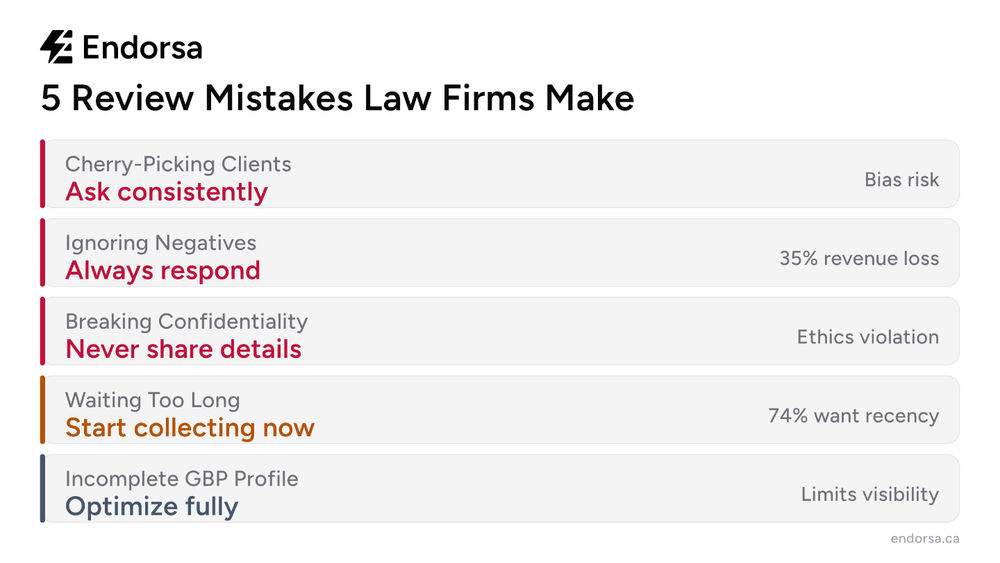
Five common mistakes cost law firms reviews, clients, and rankings:
Only asking satisfied clients. Cherry-picking who you ask creates an unsustainable pattern and can look suspicious to Google's review algorithms. Ask consistently across all cases that conclude positively.
Ignoring negative reviews. An unanswered negative review tells potential clients you don't care. Responding professionally, even briefly, shows accountability. Firms that respond to reviews earn 35% more revenue on average, according to Womply's research.
Violating confidentiality in responses. Never confirm case details, legal outcomes, or the nature of the legal matter in your review response. A simple "thank you for your feedback" protects both you and your client.
Waiting months to start collecting reviews. Review recency matters. 74% of consumers only care about reviews from the last 90 days, according to BrightLocal. Starting late means months of catching up while competitors build fresh profiles.
No Google Business Profile optimization. Reviews live on your Google Business Profile. If your profile is incomplete (missing photos, hours, practice areas, service descriptions), reviews alone won't maximize your local search visibility. Keep your Google Business Profile updated alongside your review strategy.
How Endorsa Helps Law Firms Collect More Reviews
We built Endorsa to take the manual work out of review collection, and it works especially well for law firms that need a consistent, professional approach.
Our platform automates the entire process: connect your client management tools (or upload a contact list), set your review request timing, and let the system send personalized SMS and email requests with a direct Google review link. You don't need to remember to ask, train staff on scripts, or manually send follow-up messages.
For firms with multiple offices, our multi-location dashboard consolidates all your reviews into a single view. You can monitor incoming reviews, respond quickly using our AI-powered response assistant, and track your review growth across every location.
We also built CASL compliance into our workflows from the ground up, which matters for Canadian law firms that need to follow anti-spam rules when sending electronic review requests. Every request includes proper identification and opt-out options.
Book a free demo to see how Endorsa works for legal practices. Setup takes minutes, not days.
Frequently Asked Questions
How many Google reviews should a law firm have?
Most law firms should aim for at least 20 to 30 genuine reviews as a starting point, with personal injury and family law firms targeting 50 or more. The key benchmark is having more recent reviews than your direct competitors in the local pack. Review quantity and recency both factor into Google's local ranking algorithm, so consistency matters more than hitting a single number.
Can lawyers ask clients for Google reviews?
Yes. Attorneys in most jurisdictions can request Google reviews from clients, as long as they do not offer incentives, pressure clients, or ask for reviews that would require disclosing confidential case information. Check your state or provincial bar association's advertising and solicitation rules for specific guidance. Google's own policies also prohibit incentivized reviews.
How should a law firm respond to a negative Google review?
Respond professionally and briefly. Thank the reviewer for their feedback, express concern, and invite them to contact your office directly to resolve the issue. Never confirm or deny that the person is a client, never reference case details, and never argue publicly. If the review appears to be fake, report it to Google and respond with a neutral statement noting that you have no record of the reviewer.
Do Google reviews help law firms rank higher in local search?
Yes. Google reviews are a confirmed local ranking factor. Whitespark's 2026 research shows reviews account for approximately 20% of local pack ranking factors, including review quantity, velocity, diversity, and sentiment. Law firms with strong review profiles consistently rank higher in "lawyer near me" and practice-specific local searches.
What is the best way to get Google reviews for a law firm?
The most effective approach combines timing with automation. Ask for reviews at case resolution, when satisfaction is highest, then automate follow-up requests via SMS or email with a direct Google review link. Consistent automated requests generate far more reviews than relying on staff to remember. For a step-by-step breakdown, see our guide on how to get more Google reviews.
Are there ethical rules about soliciting reviews for law firms in Canada?
Canadian law firms must follow both provincial Law Society advertising rules and CASL when soliciting reviews electronically. CASL requires proper sender identification, an unsubscribe mechanism, and implied or express consent before sending commercial electronic messages. Provincial regulators may also restrict how testimonials and endorsements are used in lawyer advertising. Using a CASL-compliant platform for review requests helps ensure compliance.
Build Your Law Firm's Reputation One Review at a Time
Google reviews for law firms are not optional in 2026. They drive local search visibility, build the trust that converts searchers into clients, and create a competitive advantage that paid advertising alone cannot replicate. The firms that collect reviews consistently, respond professionally, and respect ethical boundaries will win more consultations than those that ignore this channel.
Endorsa makes this process automatic and compliant for legal practices of any size. Start collecting reviews today with a free demo.