How Online Reputation Affects Revenue: Data and Strategies (2026)
Your online reputation directly impacts revenue. See the data on how Google reviews, star ratings, and response rates drive sales for local businesses in 2026.


Published at:
Updated at:Your online reputation directly affects your revenue. Businesses with strong Google review profiles earn more, rank higher in local search, and convert more browsers into buyers. The connection between reviews and revenue is not theoretical; it is backed by years of research from Harvard Business School, BrightLocal, and the Spiegel Research Center.
This guide breaks down exactly how your star rating, review count, response habits, and review freshness translate to real dollars, and what you can do about each one starting today.
If you want to see how automated review collection can improve your bottom line, book a free demo of Endorsa to see it in action.
How Online Reputation Drives Revenue in 2026
Online reputation is the single biggest trust signal for local businesses in 2026. According to BrightLocal's 2026 Consumer Review Survey, 98% of consumers read online reviews for local businesses before making a purchase decision. That number has held steady for three years, confirming that reviews are not a passing trend; they are a permanent part of how people spend money.
The revenue connection works through three channels:
Trust and conversion. Consumers use reviews to decide whether to contact, visit, or buy from a business. A strong review profile removes doubt and shortens the path from search to sale. A weak one sends customers to your competitor.
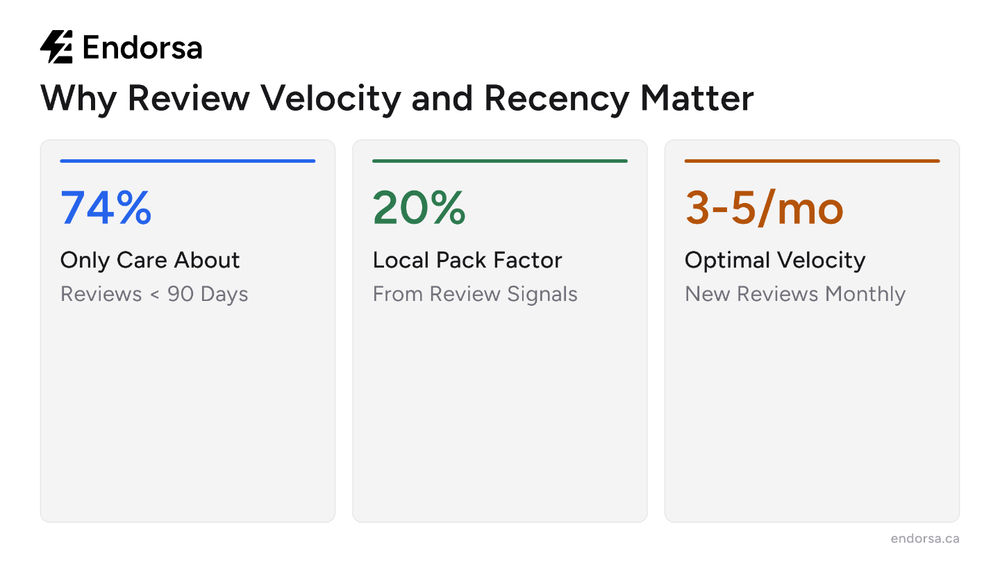
Local search visibility. Google uses review signals, including quantity, velocity, sentiment, and owner responses, as ranking factors in local search. Whitespark's 2026 Local Search Ranking Factors study confirms that reviews now account for approximately 20% of local pack ranking factors, up from 16% in 2023. Higher visibility means more clicks, more calls, and more revenue.
AI search citations. ChatGPT, Perplexity, Google AI Overviews, and other AI search tools pull from review data and cite businesses with strong reputations. Businesses with well-managed review profiles are more likely to appear in AI-generated answers, which now influence 87.4% of AI referral traffic according to Conductor's 2026 benchmarks.
Businesses that maintain a 4.5+ star rating with regular review activity appear in significantly more local search results than those with stale or low-rated profiles.
The Revenue Data: What Research Actually Shows
The financial impact of online reputation is not vague or directional. Multiple peer-reviewed studies and large-scale surveys put specific numbers on it.
Revenue Metric | Impact | Source |
|---|---|---|
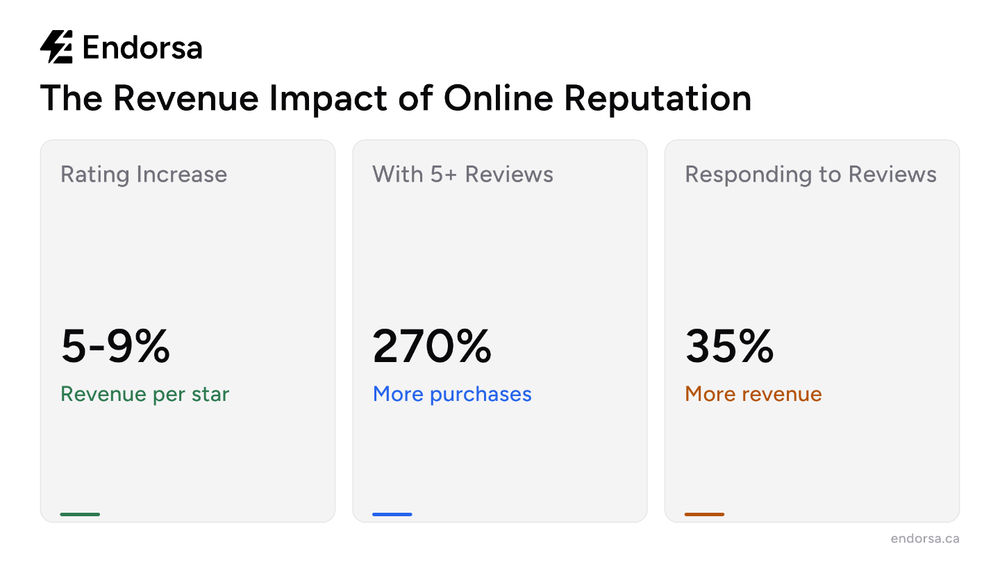
1-star rating increase on Google | 5-9% revenue increase | Harvard Business School |
Every 10 new reviews | 2.8% conversion increase | Spiegel Research Center |
Responding to 25% of reviews | 4.1% conversion improvement | Womply/Whitespark |
Products with 5+ reviews | 270% higher purchase likelihood | Spiegel Research Center |
Businesses responding to reviews | 35% more revenue on average | Womply Research |
Harvard Business School's landmark research by Michael Luca found that a one-star increase in a business's average rating leads to a 5-9% increase in revenue. This study has been cited over 1,700 times and remains the most referenced data point in the reputation-revenue conversation.
The Spiegel Research Center at Northwestern reinforced this with a study showing that products with five or more reviews are 270% more likely to be purchased than products with zero reviews. For higher-priced products, the effect is even stronger: reviews increase purchase likelihood by 380% for premium items. This is especially relevant in industries like real estate, where a single transaction can exceed $500,000 and buyers rely heavily on Google reviews for real estate agents before choosing who to work with.
These are not small numbers. For a local business generating $500,000 in annual revenue, even a modest improvement in star rating or review count could mean $25,000 to $45,000 in additional revenue per year.
How Star Ratings Translate to Revenue
Star ratings are the first thing consumers see, and they function as a binary filter. According to BrightLocal's consumer research, 68% of consumers will not use a business rated below 4 stars. Another 31% will only consider businesses rated 4.5 stars or higher.
This means a business sitting at 3.8 stars is invisible to nearly seven out of ten potential customers before they even read a single review.
The revenue impact by rating tier breaks down roughly as follows:
Star Rating | Consumer Trust Level | Revenue Impact |
|---|---|---|
4.5 - 5.0 | High trust, premium positioning | Maximum conversion, can command higher prices |
4.0 - 4.4 | Solid trust, competitive | Strong conversion, standard pricing |
3.5 - 3.9 | Moderate trust, hesitation | Significant drop in conversion (up to 68% filter out) |
Below 3.5 | Low trust, avoidance | Severe revenue loss, most consumers skip entirely |
There is one important nuance: a perfect 5.0 rating can actually reduce trust. The Spiegel Research Center found that purchase likelihood peaks between 4.0 and 4.7 stars. Consumers are skeptical of perfect ratings because they seem too good to be real. A mix of mostly positive reviews with a few constructive critiques signals authenticity.
68% of consumers will not use a business rated below 4 stars, making your star rating the most important first impression your business makes online.
For businesses with a rating below 4.0, improving that number is the single highest-ROI activity available. Each tenth of a star gained represents real customers who will now consider your business instead of scrolling past it.
The Revenue Impact of Responding to Reviews
Collecting reviews is only half the equation. How you respond to them has a measurable impact on revenue that most businesses overlook.
Research from Womply shows that businesses that respond to reviews earn 35% more revenue than businesses that do not respond. The reason is straightforward: responses signal that a real person is behind the business and that customer feedback matters.
The data gets more specific:
Responding to just 25% of reviews improves conversion rates by 4.1%
Businesses that respond to reviews see an average 0.12 star improvement in their overall rating over six months
53% of customers expect a review response within 7 days, and faster response times correlate with higher trust scores
Only 36% of small businesses actively respond to Google reviews, meaning this is a genuine competitive advantage for businesses that commit to it
Negative reviews actually present the biggest revenue opportunity. When a business responds thoughtfully to a negative review, 45% of consumers say they are more likely to visit that business compared to a business with no negative reviews at all. The response demonstrates accountability and customer care.
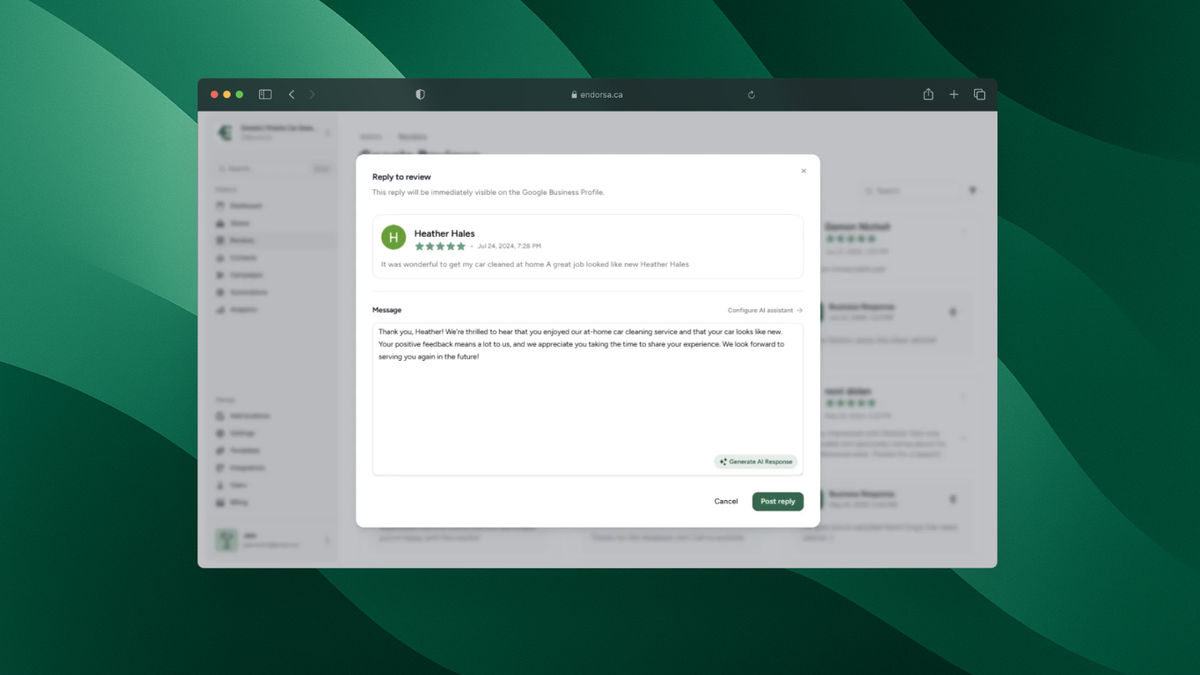
The challenge is time. Responding to every review manually takes 10-20 minutes per response when you factor in reading the review, crafting a personalized reply, and maintaining a consistent tone. For a business receiving 15-20 reviews per month, that adds up to 5+ hours of work. This is where AI-powered response tools become valuable. We built our AI review response tool specifically for this: it drafts personalized responses that match your business's tone, so you can approve and send them in seconds instead of spending the time writing from scratch.
Why Review Velocity and Recency Matter for Revenue
Review velocity (how frequently you receive new reviews) and review recency (how recent your reviews are) both influence revenue, and most businesses underestimate their importance.
BrightLocal's research found that 74% of consumers only care about reviews from the last 90 days. A business with 200 reviews that are all more than a year old will lose to a competitor with 50 recent reviews in both consumer trust and Google's ranking algorithm.
Google specifically uses review velocity as a ranking signal. A steady stream of new reviews tells Google that the business is active, relevant, and engaging with customers. A sudden stop in reviews, or a suspicious burst of 20 reviews in one week followed by silence, can trigger algorithmic flags.
The revenue implications are clear:
Businesses with recent reviews (last 30 days) convert at higher rates than those with stale profiles
Review velocity is a component of the 20% review signal in local pack rankings
A consistent cadence of 3-5 new reviews per month is more valuable than occasional bursts
This is why manual review collection fails for most businesses. When review collection depends on someone remembering to ask, the cadence is inconsistent. Automated review request systems solve this by sending requests after every customer interaction, maintaining the steady velocity that both consumers and Google reward.
Endorsa is a Google review automation platform built in Canada that helps businesses collect, manage, and respond to reviews on autopilot. Our platform syncs with tools like Stripe, HubSpot, and QuickBooks to send review requests automatically after each transaction, keeping your review velocity consistent without manual effort.
Common Reputation Mistakes That Cost Businesses Revenue
Understanding the data is one thing. Avoiding the mistakes that silently drain revenue is another.
Ignoring reviews entirely. 64% of small businesses do not actively manage their Google reviews. They are leaving money on the table. Every unanswered review is a missed signal to both potential customers and Google's algorithm.
Responding only to negative reviews. Some businesses only engage when something goes wrong. This creates a visible pattern where all responses are defensive. Responding to positive reviews shows appreciation and encourages repeat business. Use response templates to make this faster.
Asking for reviews inconsistently. A burst of review requests after a marketing meeting, followed by months of silence, creates an unnatural pattern. Worse, it means you are missing the window when customers are most likely to leave a positive review: within 24-48 hours of their experience.
Not having a direct review link. If customers have to search for your business on Google, find the review button, and figure out how to leave a review, most will abandon the process. A direct Google review link shared via SMS or email reduces friction and significantly increases completion rates.
Cherry-picking who you ask. Asking only customers you think will leave positive reviews is a violation of Google's review policies and creates an artificially inflated rating that erodes trust. Ask every customer. Businesses that ask consistently build authentic profiles that perform better long-term.
How Endorsa Helps You Turn Reviews Into Revenue
We built Endorsa because we saw the gap between knowing reviews matter and actually doing something about it. Most business owners understand that reputation drives revenue, but they do not have the time to manually chase reviews, craft responses, and monitor their Google Business Profile every day.
Our platform automates the entire review lifecycle:
Automated review requests via SMS and email, triggered by customer transactions through your existing tools (Stripe, HubSpot, QuickBooks, Zapier). No manual follow-up needed.
AI-powered review responses that match your business's tone and let you respond to every review in seconds, not minutes.
Multi-location dashboard that consolidates reviews across all your locations into a single view, so you can manage and respond to Google reviews from one place.
CASL-compliant workflows for Canadian businesses, with proper consent management and unsubscribe handling built into every campaign. This is a genuine differentiator; most US-based review tools do not account for Canadian anti-spam law.
The result is a consistent review velocity, faster response times, and a stronger star rating, all of which translate directly to the revenue improvements the research documents.
Book a free demo to see how automated review collection works for your business.
Frequently Asked Questions
How much revenue can a business gain from improving its online reputation?
Research from Harvard Business School shows that a one-star improvement in average rating leads to a 5-9% revenue increase. For a business earning $500,000 per year, that translates to $25,000-$45,000 in additional annual revenue. The exact impact depends on industry, location, and competitive landscape.
Do 90% of consumers read online reviews before visiting a business?
The commonly cited figure is 98%, according to BrightLocal's 2026 Consumer Review Survey. Some older surveys cite 90%, but the most current data shows that virtually all consumers check reviews before making local purchasing decisions.
What star rating do customers trust most?
Consumers trust ratings between 4.0 and 4.7 stars the most. The Spiegel Research Center found that purchase likelihood actually decreases for businesses with a perfect 5.0 rating because consumers perceive it as potentially inauthentic.
Does responding to reviews actually increase revenue?
Yes. Businesses that respond to reviews earn 35% more revenue on average than businesses that ignore them. Responding signals that a real person cares about customer feedback, which builds trust and increases conversion rates.
How many reviews does a business need to build trust?
The Spiegel Research Center found that the biggest conversion jump happens between zero and five reviews (270% increase in purchase likelihood). Beyond that, more reviews continue to help, but with diminishing returns. For local businesses, 40+ reviews with a steady stream of new ones is a strong foundation.
How do Google reviews affect local search rankings?
Google reviews account for approximately 20% of local pack ranking factors according to Whitespark's 2026 study. Google evaluates review quantity, velocity, sentiment, keyword relevance, and whether the business responds to reviews. Businesses with strong review signals rank higher in the local pack, which receives 70%+ of local search clicks.
Your Reputation Is Your Revenue
The data is consistent across every major study: your online reputation directly affects your revenue. Star ratings filter who considers your business. Review quantity and recency determine your local search visibility. Response habits influence whether browsers become buyers.
The businesses that treat review management as a revenue activity, not a marketing afterthought, are the ones seeing measurable growth. Endorsa automates the entire process so you can focus on running your business while your review profile works for you.
Start collecting reviews today with a free demo.