Google Reviews for Restaurants: Complete Guide (2026)
Learn how to get more Google reviews for your restaurant with 7 proven strategies, response templates, and industry benchmarks. Built by Endorsa.


Published at:
Updated at:Google reviews for restaurants are the single biggest factor in whether a new customer walks through your door or scrolls past to a competitor. With 98% of consumers reading online reviews before choosing a local business, restaurants face more review pressure than almost any other industry. This guide covers everything restaurant owners need to know: how many reviews you actually need, proven strategies to collect more, and templates for responding to every type of review.
Want to automate your restaurant's review collection instead of doing it all manually? Book a free demo of Endorsa to see how it works.
Why Google Reviews Matter More for Restaurants Than Almost Any Other Industry
Restaurants depend on Google reviews more than most businesses because dining is a high-trust, high-frequency decision. Consumers research restaurants before nearly every visit, and Google is where that research starts.
The numbers back this up. According to Whitespark's local search ranking factors study, reviews account for approximately 20% of local pack ranking factors. For restaurants, this impact is amplified because "near me" searches for food dominate local search volume. 76% of people who search for something nearby on their phone visit a business within 24 hours, and restaurants are the most common destination.
Google reviews also directly affect your revenue. The Spiegel Research Center found that every 10 new reviews increases conversion by 2.8%. For a restaurant doing $500,000 CAD in annual revenue, that translates to $14,000 in additional sales from reviews alone.Here is what makes restaurants unique:
Factor | Restaurants | Other Local Businesses |
|---|---|---|
Review frequency | Customers visit weekly or monthly | Customers visit once or a few times per year |
Decision speed | Diners choose in minutes | Purchases often take days or weeks |
Visual expectations | Food photos in reviews drive decisions | Photos matter less for most services |
Emotional weight | Bad meal = strong emotional reaction | Service issues are often less personal |
According to BrightLocal's consumer review survey, 68% of consumers will not use a business rated below 4 stars. For restaurants, where competition is fierce in every neighbourhood, that threshold is a survival metric.
How Many Google Reviews Does the Average Restaurant Have?
The average restaurant in a mid-size city has between 50 and 200 Google reviews, but top performers in competitive markets often have 500 or more. The number you need depends on your local competition, not a universal benchmark.
Here is a practical framework for restaurant review targets:
Restaurant Type | Minimum Reviews for Trust | Competitive Advantage Threshold |
|---|---|---|
New restaurant (under 1 year) | 20-40 reviews | 75+ reviews |
Established casual dining | 50-100 reviews | 200+ reviews |
Fine dining | 30-60 reviews | 150+ reviews |
Fast casual or takeout | 40-80 reviews | 250+ reviews |
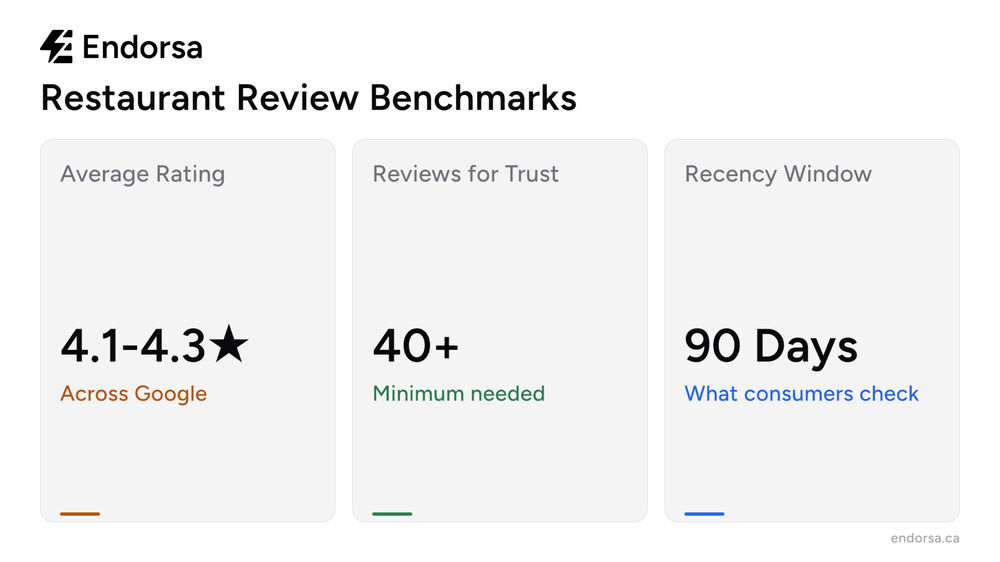
What matters more than raw count is review velocity, which is the rate at which new reviews come in. Google's algorithm favours businesses with a steady stream of recent reviews over those with a large total but no new activity. BrightLocal's research shows that 74% of consumers only care about reviews from the last 90 days, which means a restaurant with 50 reviews from this quarter outperforms one with 300 reviews but nothing recent.
The average restaurant rating across Google sits between 4.1 and 4.3 stars. If your restaurant is below 4.0, collecting new positive reviews should be your top priority. If you are above 4.5, focus on maintaining velocity and responding to every review.
7 Proven Strategies to Get More Restaurant Reviews
Getting more Google reviews for your restaurant comes down to asking at the right time, making it simple, and building the habit into your operations. These seven strategies work for every type of restaurant, from food trucks to fine dining.
1. Ask After the Peak Moment of Satisfaction
The best time to ask for a review is immediately after a positive interaction, not when the customer is paying the bill. For table service restaurants, this is right after the server checks in and gets a compliment. For quick-service, it is at the pickup counter when the customer looks pleased.
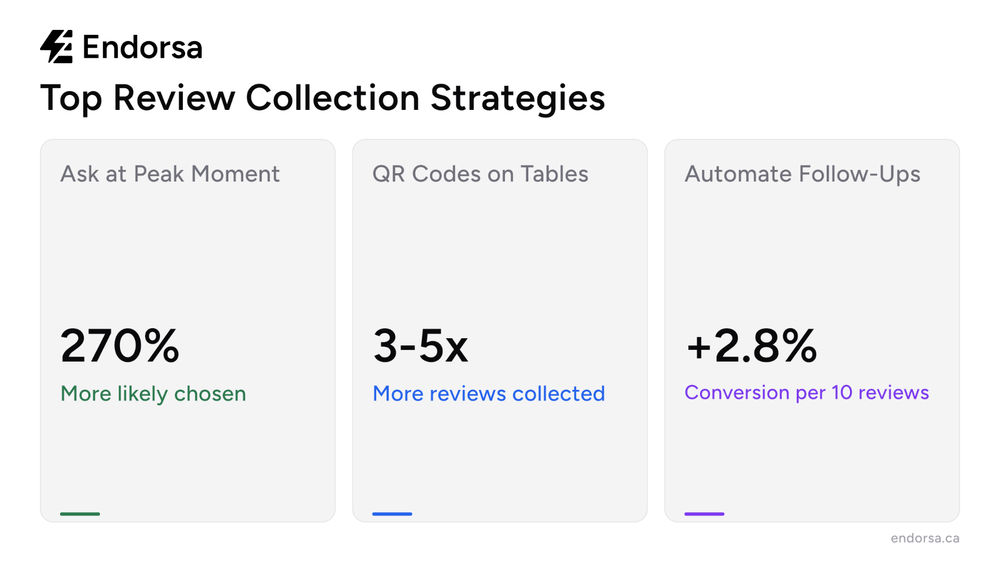
Train your staff with a simple script: "We are so glad you enjoyed it. If you have 30 seconds, a Google review really helps us out." Keep it casual. Keep it brief. The Spiegel Research Center confirms that products and businesses with just 5 reviews are 270% more likely to be chosen, so even a small increase in ask frequency produces outsized results.
2. Put QR Codes on Every Table and Receipt
A QR code that links directly to your Google review page removes every friction point. Customers do not need to search for your business, find the review button, or remember to do it later. They scan, tap, and write.
Print QR codes on table tents, receipt footers, and takeout bag stickers. Use Google's built-in review link from your Google Business Profile dashboard, or create a short link with a tracking parameter so you can measure which placements drive the most reviews. For a step-by-step guide on setting this up, see our article on how to create and share your Google review link.
3. Follow Up After Online and Delivery Orders
In-house diners get asked for reviews in person, but your online order and delivery customers are often forgotten. These customers represent a growing share of restaurant revenue, and they are just as likely to leave a review if you ask.
Send a follow-up SMS or email 1 to 2 hours after delivery. Keep the message short: "Thanks for ordering from [Restaurant Name]. How was everything? If you enjoyed it, a quick Google review means a lot to us: [link]."
This is where automation changes the game. Instead of relying on your staff to remember, tools like Endorsa sync your customer list from your POS or payment system and send review requests automatically after each transaction. For Canadian restaurants, any SMS or email review requests must comply with CASL (Canada's Anti-Spam Legislation), which requires express or implied consent before sending commercial messages.
4. Respond to Every Review Within 24 Hours
Responding to reviews is not just good customer service; it directly generates more reviews. When potential reviewers see that the restaurant owner actively reads and replies, they feel their review will be noticed and valued. That social proof encourages more customers to leave feedback.
The data supports this: businesses that respond to just 25% of reviews see a 4.1% improvement in conversion, and responding consistently leads to a 0.12 star rating improvement over six months. For restaurants, where even a 0.1 star difference can mean ranking above or below a competitor in the local pack, this is significant.
5. Make It Part of Your Server Checkout Routine
The most consistent review collection happens when it is built into your operations, not left to individual motivation. Add a review request to the checkout flow: after presenting the bill, the server places a small card with a QR code and a brief message ("Loved your meal? Tell us on Google").
Restaurants that make this a standard part of the table turn see 3 to 5 times more reviews than those that rely on occasional asks. The key is consistency, not pressure. Never incentivize specific star ratings, as this violates Google's review policies and can result in review removal.
6. Feature Your Best Reviews on Social Media and In-Store
Sharing your best reviews on Instagram, Facebook, and in-store displays does two things. First, it shows existing reviewers that their feedback is valued and visible, which encourages repeat reviews. Second, it normalizes the act of leaving a review for customers who have not done it yet.
Create a simple template: screenshot the review, add your restaurant's branding, and post it with a thank-you message. Rotate featured reviews weekly to keep the content fresh.
7. Send a Monthly Review Request to Your Customer List
If you collect customer emails through reservations, loyalty programs, or online ordering, you have a built-in review generation channel. A monthly email with a direct Google review link, sent to customers who visited in the past 30 days, maintains a steady review velocity without overwhelming anyone.
Keep the email simple: one sentence of gratitude, one sentence asking for a review, and a prominent button linking to your Google review page. This pairs naturally with proven review generation strategies that work across any industry.
How to Respond to Restaurant Reviews (With Templates)
Responding to restaurant reviews requires industry-specific language because restaurant complaints are personal. Someone complaining about their meal is not the same as someone complaining about a late delivery from an e-commerce store. Your responses need to show that you understand the dining experience.
Here are templates for the most common restaurant review scenarios:
Positive Review (5 Stars, Mentions Specific Dish)
Thank you so much for the kind words, [Name]. We are thrilled you enjoyed the [dish name]. Our kitchen team puts a lot of care into that one, and it means the world to hear it landed well. We hope to see you again soon.
Mixed Review (3 Stars, Good Food but Slow Service)
Hi [Name], thanks for the honest feedback. We are glad the food hit the mark, and we hear you on the wait time. We have been adjusting our staffing during peak hours to improve speed without cutting corners on quality. We would love a chance to give you a better experience next time.
Negative Review (1 Star, Food Quality Complaint)
Hi [Name], thank you for letting us know. This is not the experience we want anyone to have, and we take food quality seriously. We have shared your feedback with our kitchen manager and would appreciate the chance to make it right. Please reach out to us at [email] so we can follow up directly.
Negative Review (1 Star, Suspected Fake or No Detail)
We appreciate you taking the time to leave a review. We take all feedback seriously, and we are not able to find a record of this visit. If you could share more details, we would like to look into this and make it right.
For a full library of review response templates covering every scenario, check out our guide to managing and responding to Google reviews. If writing individual responses feels overwhelming, our AI-powered review response tool generates personalized replies that match your restaurant's tone.
Only 36% of small businesses actively respond to Google reviews. For restaurants, where reviews are deeply personal and highly visible, responding to every review is one of the simplest ways to stand out from competitors who stay silent.
Restaurant Review Management Mistakes That Cost You Customers
Restaurant owners make predictable review management mistakes, and most of them are easy to fix once you know what to look for.

Ignoring reviews entirely. This is the most common mistake. When customers see a restaurant with dozens of reviews and zero owner responses, they assume management does not care about feedback. That impression costs you customers before they ever walk in.
Responding defensively to negative reviews. A combative response to a 1-star review does more damage than the review itself. Other potential customers read your responses, and a defensive tone signals that the restaurant does not handle criticism well. Always lead with empathy, even when the review feels unfair.
Buying fake reviews or incentivizing 5-star ratings. Google's detection systems are increasingly sophisticated. Fake reviews get removed, and repeated violations can result in your Google Business Profile being suspended. The short-term boost is never worth the long-term risk.
Asking for reviews only once and then stopping. Review velocity matters. A burst of 20 reviews in one week followed by months of silence looks unnatural to Google's algorithm and does not build the consistent trust signal that drives local rankings. Build review collection into your daily operations, not a one-time campaign.
Not claiming or optimizing your Google Business Profile. Your reviews live on your Google Business Profile. If you have not claimed it, optimized your categories, added photos, and filled in your hours, you are leaving ranking potential on the table. For a comprehensive guide, see our local SEO tips for Google Business Profile.
How Endorsa Helps Restaurants Get More Google Reviews
We built Endorsa specifically to solve the problem restaurant owners tell us about most: they know reviews matter, but they do not have time to chase them. Running a restaurant is already a 70-hour-a-week job, and manually texting customers for reviews falls off the list every single day.
Endorsa is a Google review automation platform built in Canada that helps businesses collect, manage, and respond to reviews on autopilot. For restaurants, here is how it works:
Automated review requests after every transaction. Our platform syncs with your payment system (Stripe, Square, or QuickBooks) and automatically sends a personalized SMS or email review request to each customer. You set it up once, and it runs on its own.
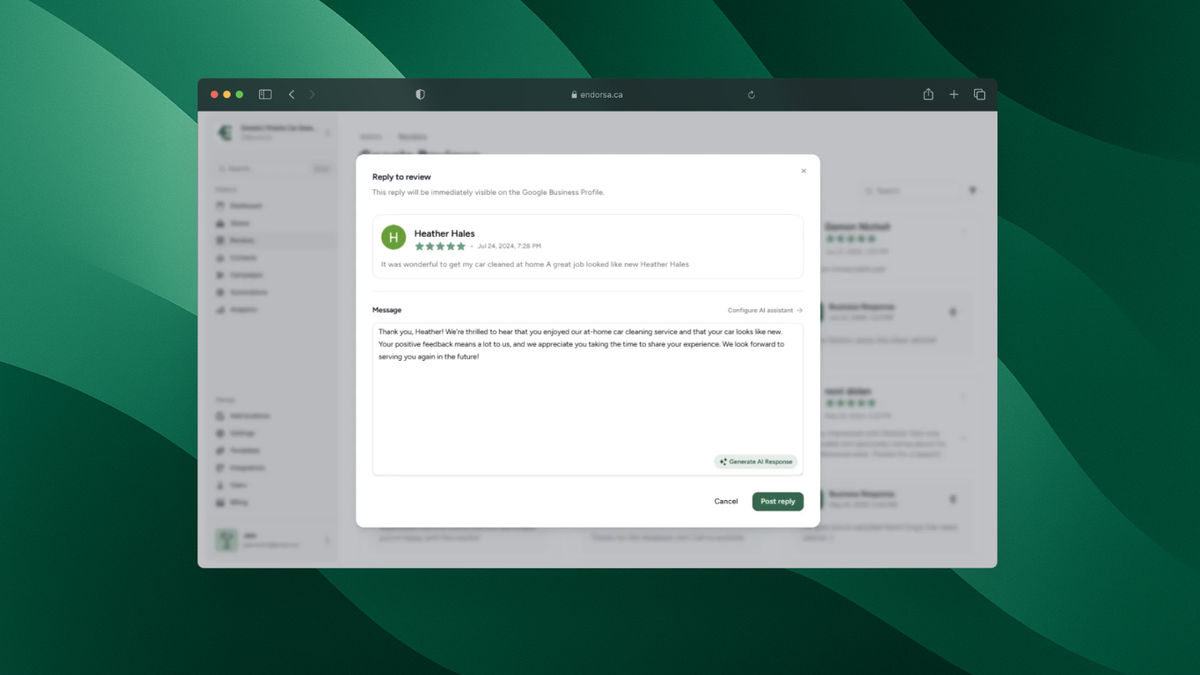
AI-powered review responses. Our AI review assistant drafts personalized responses to every review that match your restaurant's tone. You approve and send in seconds instead of spending 20 minutes writing each reply.
Multi-location dashboard. If you run more than one restaurant location, our dashboard consolidates every location's reviews into one view. No more logging in and out of separate Google Business Profiles.
CASL-compliant by design. For Canadian restaurant owners, every review request we send follows CASL guidelines. This is built into the platform, not an afterthought, which is a genuine advantage over US-only tools that do not account for Canadian anti-spam law.
Ready to stop chasing reviews manually? Book a free demo and see how restaurants like yours are collecting reviews on autopilot.
Frequently Asked Questions
How many Google reviews does a restaurant need to rank in the local pack?
There is no fixed number, but restaurants with 40 or more recent reviews and a rating above 4.0 consistently appear in the local 3-pack for competitive dining keywords. The exact threshold depends on your local market. Check how many reviews your top three competitors have, then aim to match or exceed that count within 90 days.
Can restaurants ask customers for Google reviews?
Yes. Google explicitly allows businesses to ask customers for reviews. What you cannot do is offer incentives for specific star ratings, pay for reviews, or use review gating (sending only satisfied customers to Google while routing unhappy customers elsewhere). Ask everyone, respond to everyone, and let the results speak for themselves.
How do I get a 4.9 star rating on Google?
Reaching a 4.9 requires a high volume of 5-star reviews with very few low ratings. The most effective approach is consistent service quality combined with systematic review requests after every positive interaction. Responding to negative reviews promptly and professionally also helps, as it often leads to customers updating their ratings. Google rounds to one decimal, so a 4.85 average displays as 4.9.
Should restaurants respond to every Google review?
Yes. Responding to every review, positive and negative, signals to both Google and potential customers that you value feedback. 53% of customers expect a review response within 7 days, and businesses that respond consistently earn 35% more revenue on average. For restaurants, where the dining experience is personal, a thoughtful response can turn a one-time visitor into a regular.
How quickly do new Google reviews affect restaurant search rankings?
New reviews typically begin influencing local rankings within 1 to 2 weeks, though the effect compounds over time. A single review will not dramatically shift your position, but a consistent stream of 5 to 10 reviews per month builds the velocity signal that Google's local algorithm rewards. Recency matters most: reviews from the last 90 days carry significantly more weight than older reviews.
Start Turning Diners Into Reviewers
Google reviews for restaurants are not optional in 2026. They are the foundation of how diners find you, trust you, and choose you over the restaurant down the street. The restaurants that win in local search are the ones that make review collection a daily habit, not a quarterly project.
Start with one strategy from this guide today. Put a QR code on your tables, train your servers to ask after a compliment, or set up an automated follow-up for online orders. Every review you collect compounds over time into higher rankings, more foot traffic, and more revenue.
Endorsa automates the entire process for restaurants, from collecting reviews to responding with AI, so you can focus on what you do best: feeding people great food. Book a free demo and start collecting reviews this week.