Google Reviews for Dentists: Complete Guide (2026)
Google reviews for dentists drive new patient calls and local search rankings. Learn proven strategies, response templates, and automation tips for dental practices.

Published at:
Updated at:Google reviews for dentists are the single biggest driver of new patient acquisition in 2026. Dental practices with strong Google review profiles rank higher in local search, earn more patient trust, and generate more appointment calls than practices that ignore their online reputation. This guide covers everything dental practices need to know about collecting, managing, and responding to Google reviews.
If you want to automate your dental practice's review collection, book a free demo of Endorsa to see how it works for dental offices.
Why Google Reviews Matter More for Dental Practices
Google reviews carry more weight for dental practices than for most other business types because patients choose dentists almost entirely through local search and peer recommendations. According to BrightLocal's 2026 Consumer Review Survey, 98% of consumers read online reviews for local businesses, and healthcare providers are among the most reviewed industries.
Dental care is personal, high-stakes, and often anxiety-inducing. Patients aren't just choosing a service; they're trusting someone with their health. That trust gap makes reviews unusually powerful. A potential patient who sees 150 five-star reviews describing gentle cleanings and friendly staff is far more likely to book than one who finds a practice with 12 reviews and a 3.8-star average.
The local SEO impact is equally significant. Whitespark's annual ranking study confirms that reviews now account for 20% of local pack ranking factors, making them the second most important signal after your Google Business Profile completeness. For dentists competing in a specific city or neighborhood, reviews are the differentiator between appearing in the local 3-pack and being invisible.
Dental practices with 100+ Google reviews generate significantly more new patient calls than practices with fewer than 50 reviews, according to Oral Health Group's analysis of dental practice review data.
Three specific ways reviews impact dental practices:
Local pack rankings: Google's algorithm weights review quantity, velocity, and sentiment when deciding which three dental practices appear in the map pack for "dentist near me" searches.
Patient trust and conversion: 68% of consumers won't use a business rated below 4 stars. For dental practices, where the decision involves physical health, that threshold is even stricter.
Referral replacement: Traditional word-of-mouth referrals are declining as patients move to new cities and rely on Google instead of asking neighbors. Reviews are the new referral.
How Many Reviews Does the Average Dental Practice Have?
The average dental practice in a mid-sized city has between 40 and 80 Google reviews. Practices in competitive urban markets like Toronto, Vancouver, Los Angeles, or New York often have 150 to 300+ reviews. The number you need depends on your market and specialty.
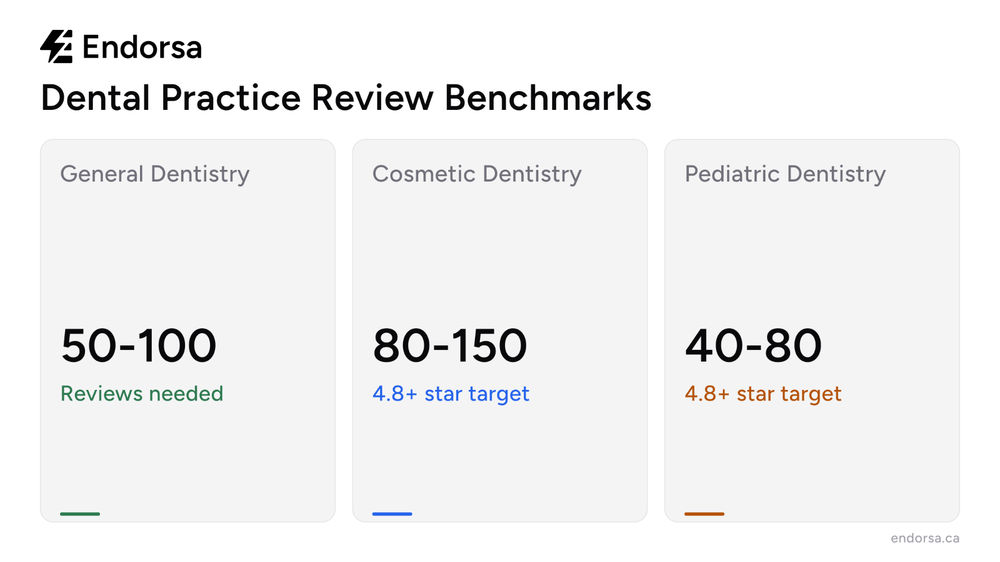
Practice Type | Avg Reviews | Target Rating | Competitive Threshold |
|---|---|---|---|
General Dentistry | 50-100 | 4.7+ stars | 100+ reviews |
Cosmetic Dentistry | 80-150 | 4.8+ stars | 150+ reviews |
Pediatric Dentistry | 40-80 | 4.8+ stars | 80+ reviews |
Orthodontics | 60-120 | 4.7+ stars | 120+ reviews |
Emergency/Walk-in | 30-60 | 4.5+ stars | 60+ reviews |
These benchmarks come from analyzing Google Business Profile data across dental practices in North American markets. Your specific target depends on what competing practices in your area have. Search "dentist near me" from your office location and note the review counts and ratings in the local pack. Those are the numbers you need to match or exceed.
The Spiegel Research Center found that every 10 new reviews increases conversion by 2.8%. For a dental practice, that means 10 new Google reviews could translate to 2-3 additional new patient appointments per month, which often represent $500-$2,000+ each in lifetime patient value.
7 Proven Strategies to Get More Dental Patient Reviews
Getting more Google reviews for your dental practice requires a systematic approach, not a one-time effort. The practices that consistently collect reviews build it into their patient workflow.
1. Ask at the Right Moment
The best time to ask a dental patient for a review is immediately after a positive experience, while they're still in the office. After a successful cleaning, a pain-free filling, or a cosmetic procedure reveal, the patient's satisfaction is at its peak. Train your front desk team to ask during checkout: "We're so glad your visit went well. Would you mind leaving us a quick Google review? It really helps other patients find us."
2. Use a Google Review Link and QR Code
Make it as easy as possible for patients to leave a review. Create a direct Google review link for your practice and generate a QR code from it. Place QR codes at the checkout desk, in operatory rooms, on appointment reminder cards, and on your practice's business cards. When the review is two taps away, completion rates increase significantly.
3. Send Automated Review Requests After Appointments
Manual review requests depend on your team remembering, which they won't do consistently during busy appointment blocks. Automation solves this. When a patient's appointment ends, an automated SMS or email goes out within 1-2 hours with a direct link to your Google review page. This is where tools like Endorsa connect to your practice management or payment system and send personalized review requests without any manual effort from your staff.
4. Follow Up Once (and Only Once)
If a patient doesn't leave a review after the first request, one follow-up message 3-5 days later is appropriate. More than one follow-up feels pushy and can damage the patient relationship. The follow-up should be friendly and brief: "Hi [Name], we hope you're feeling great after your visit. If you have a moment, we'd love your feedback on Google."
5. Respond to Every Review Publicly
Patients who see that a dentist personally responds to reviews are more likely to leave their own. It signals that the practice values patient feedback. Responding also improves your Google Business Profile's engagement signals, which can boost local rankings. We cover response strategies in detail in the next section.
6. Feature Reviews on Your Website and Social Media
Sharing positive Google reviews on your practice's Instagram, Facebook, or website does two things: it shows appreciation to the reviewer, and it reminds other patients that leaving reviews is normal and valued. A simple "Patient Spotlight" post once a week featuring a great Google review keeps the review conversation active.
7. Make It Part of Your New Patient Onboarding
Include a review request as part of your new patient workflow. After a new patient's first visit, they're forming their first impression of your practice. If that impression is positive, that's the best review you'll ever get because new patients bring fresh perspective and enthusiasm. Add a review request to your post-first-visit email sequence.

How to Respond to Dental Practice Reviews (With Templates)
Responding to Google reviews is just as important as collecting them. Businesses that respond to reviews earn 35% more revenue on average, and for dental practices, responses demonstrate the bedside manner that patients are evaluating before they ever walk through the door.
Here are response templates for the four most common dental review scenarios:
Positive Review (5-Star, Mentions Specific Treatment):
Thank you so much, [Name]! We're thrilled to hear your [cleaning/filling/crown] went smoothly and that you felt comfortable throughout the process. Our team works hard to make every visit as stress-free as possible. We look forward to seeing you at your next appointment!
Mixed Review (3-4 Stars, Compliment With Concern):
Thank you for your feedback, [Name]. We're glad you had a positive experience with Dr. [Name] and our hygiene team. We take your concern about [wait time/billing/scheduling] seriously and are working to improve that part of the experience. Please feel free to call us directly at [number] so we can make it right.
Negative Review (1-2 Stars, Service Complaint):
[Name], we're sorry your visit didn't meet the standard we set for ourselves. Every patient deserves an excellent experience, and we clearly fell short. We'd like to understand what happened and how we can improve. Please reach out to our office manager at [email/phone] so we can address this directly.
Suspected Fake or Spam Review:
We don't have a record of your visit in our system, but we take all feedback seriously. If you are a patient, please contact our office at [number] so we can look into this. We want to make sure every patient has a great experience.
For more review response examples across different scenarios, see our complete guide to Google review response templates.
Key principles for dental review responses: respond within 48 hours, personalize every reply (never copy-paste the same response to multiple reviews), keep HIPAA in mind (never reference specific treatments, diagnoses, or patient health information in a public response), and always take negative conversations offline.
Dental-Specific Review Management Mistakes
Dental practices make several review mistakes that other business types don't typically face. Avoiding these protects your reputation and your practice.
1. Violating HIPAA in review responses. This is the most serious mistake a dental practice can make with reviews. Never confirm that someone is a patient, reference their treatment, or discuss their health status in a public review response. Even well-intentioned responses like "We're glad your root canal went well!" can constitute a HIPAA violation. Keep responses general and move specific conversations to private channels.
2. Ignoring negative reviews about wait times and billing. The two most common dental complaints on Google are long wait times and unexpected costs. These aren't clinical complaints; they're operational complaints, and patients hold them against you just as heavily. Address them directly in your response and fix the underlying process.
3. Asking for reviews only after good experiences. Some practices only send review requests to patients who seem happy. This creates an inauthentic review profile and, more importantly, violates Google's review policies. Ask every patient consistently. If your service is genuinely good, your average will reflect that.
4. Relying entirely on the front desk to ask. Front desk staff are juggling scheduling, insurance verification, phone calls, and patient check-ins. Asking for reviews is important but rarely urgent, so it gets dropped. Automating review requests ensures consistency without adding to your team's workload.
5. Not monitoring reviews across locations. Multi-location dental groups often have separate Google Business Profiles for each office, and reviews come in at different rates and with different issues. Without a centralized dashboard, negative reviews at one location can go unnoticed for weeks.
How Endorsa Helps Dental Practices Get More Reviews
We built Endorsa to solve the exact problem dental practices face with reviews: the gap between knowing reviews matter and actually collecting them consistently. Endorsa is a Google review automation platform built in Canada that helps businesses collect, manage, and respond to reviews on autopilot.
For dental practices specifically, our platform connects to your existing tools, whether that's Stripe for payment processing, HubSpot for patient CRM, or QuickBooks for billing, and automatically sends personalized review requests via SMS or email after each appointment. Your front desk doesn't need to remember to ask. Your patients get a friendly, well-timed message with a direct link to leave a Google review.
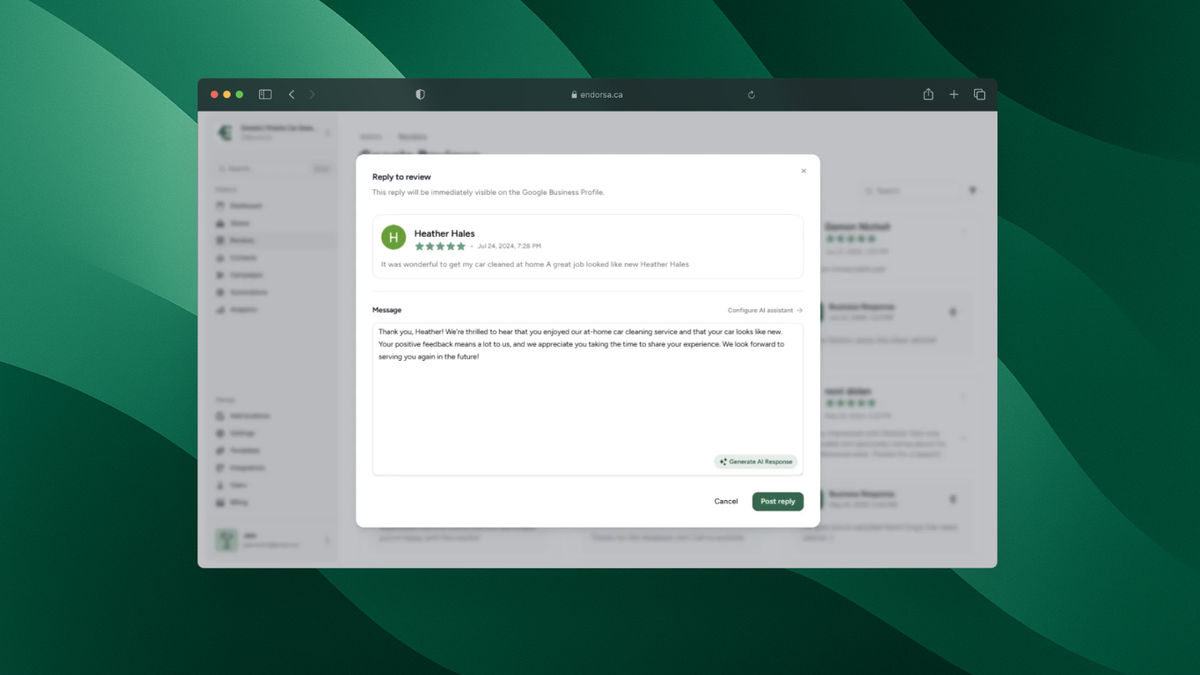
Our AI review response tool drafts personalized responses to every review that match your practice's tone, so you can approve and send replies in seconds instead of spending time writing each one from scratch. For multi-location dental groups, our dashboard consolidates every location's reviews into a single view.
For Canadian dental practices, our review request workflows are built with CASL (Canadian Anti-Spam Legislation) compliance in mind, so you can automate SMS and email requests without worrying about regulatory issues.
Book a free demo to see how Endorsa works for dental practices.
Frequently Asked Questions
How many Google reviews does a dental practice need?
Most dental practices need at least 50 Google reviews to compete in the local pack, with a target rating of 4.7 stars or higher. In competitive urban markets, 100+ reviews is the threshold for standing out. The specific number depends on what your direct competitors in your area have; search "dentist near me" from your office location to benchmark.
How do you ask dental patients for Google reviews without being pushy?
Ask at the right moment, immediately after a positive experience while the patient is still in the office. Keep the request simple and genuine: "We're glad your visit went well. Would you mind leaving us a quick Google review?" Automated follow-up via SMS or email 1-2 hours after the appointment feels natural, not pushy, because the timing matches when patients are reflecting on their visit.
Should dentists respond to negative Google reviews?
Yes, always. Responding to negative reviews shows prospective patients that your practice takes feedback seriously and is committed to improving. Keep responses professional, empathetic, and brief. Never reference specific treatments or confirm patient status (HIPAA applies). Move the conversation to a private channel by providing a direct phone number or email.
Do Google reviews help dental practices rank higher in local search?
Google reviews directly impact local search rankings for dental practices. Whitespark's 2026 research shows reviews account for 20% of local pack factors, including review quantity, velocity (how frequently new reviews come in), diversity, and sentiment. A dental practice with 100 recent, positive reviews will consistently outrank a competitor with 20 older reviews.
Can dental practices automate Google review requests?
Yes. Automation tools connect to your practice management software, payment processor, or CRM and send personalized review requests via SMS or email after each patient visit. This removes the burden from front desk staff and ensures every patient gets asked consistently. For Canadian dental offices, look for platforms that include CASL compliance to handle anti-spam regulations automatically.
What star rating do patients expect from a dental practice?
68% of consumers won't use a business rated below 4 stars, and 31% specifically look for 4.5 stars or higher. For dental practices, where trust and anxiety are major factors, maintaining a 4.7+ star average is the practical minimum for attracting new patients through Google.
Start Building Your Dental Practice's Review Reputation Today
Google reviews for dentists are not optional in 2026; they are the foundation of how patients find and choose dental providers. The practices that build a consistent review collection system, respond to every review thoughtfully, and avoid common mistakes like HIPAA violations in responses will dominate local search in their market. Endorsa automates the entire review collection process for dental practices, from the first SMS request to the AI-drafted response. Book a free demo to see how it works for your practice.